Explore our complete series on AI search and AI visibility for businesses.
For more than two decades, Google Search has been built around keywords, links, and website visits. With the rollout of Google AI search and AI Mode, that experience is becoming far more conversational. At Google I/O 2026, Google announced major updates focused on AI-powered answers, task completion, and personalized discovery.
This doesn’t mean websites are disappearing. Google AI search still relies on web content, publishers, and authoritative sources to generate recommendations. But it does change how people discover information online.
Search is becoming more assistive, conversational, and focused on helping users find answers directly.
In This Guide
Google AI Search Is Becoming More Conversational
Google is increasingly turning Search into an interactive AI experience through its new interface called AI Mode, powered globally by Gemini 3.5 Flash.
AI Mode moves Search beyond traditional keyword queries and toward ongoing conversational interactions where users can ask layered follow-up questions, compare information, and explore topics in more depth.
And users are no longer just typing longer prompts. One of the biggest shifts in AI-powered search is multimodal input. Users can now ask questions about:
- Uploaded images
- Videos
- Documents
- Screenshots
- Entire Chrome tabs
Instead of typing:
“best project management software”
Users may now upload spreadsheets, screenshots, or browser tabs and ask:
“Which platform would integrate best with this workflow?”
That changes how search intent is expressed and how businesses think about content visibility.
Businesses are already adapting as conversational and AI-assisted search usage continues to grow.
Google states that AI Mode and related AI-powered search experiences have crossed more than 1 billion users globally, signaling that conversational search is becoming mainstream rather than experimental.
AI Overviews Are Changing Search Behavior
One of the biggest changes is the expansion of AI Overviews, AI-generated summaries that appear at the top of some search results. These summaries can reduce the need for users to click through multiple pages to gather information.
This broader shift toward AI-generated answers is also accelerating the rise of zero-click searches, where users get information directly within Google without visiting external websites.
However, AI Overviews are not appearing consistently across all searches. After early criticism surrounding inaccurate or low-quality AI responses, Google scaled back AI-generated answers for certain categories, including highly sensitive news, medical, and rapidly changing topics, where freshness and factual accuracy are critical. That nuance matters.
Google is clearly moving toward AI-assisted search experiences, but it is also being cautious in areas where incorrect information could create serious problems.
Visual Case Study: AI Mode vs. Traditional Google Search
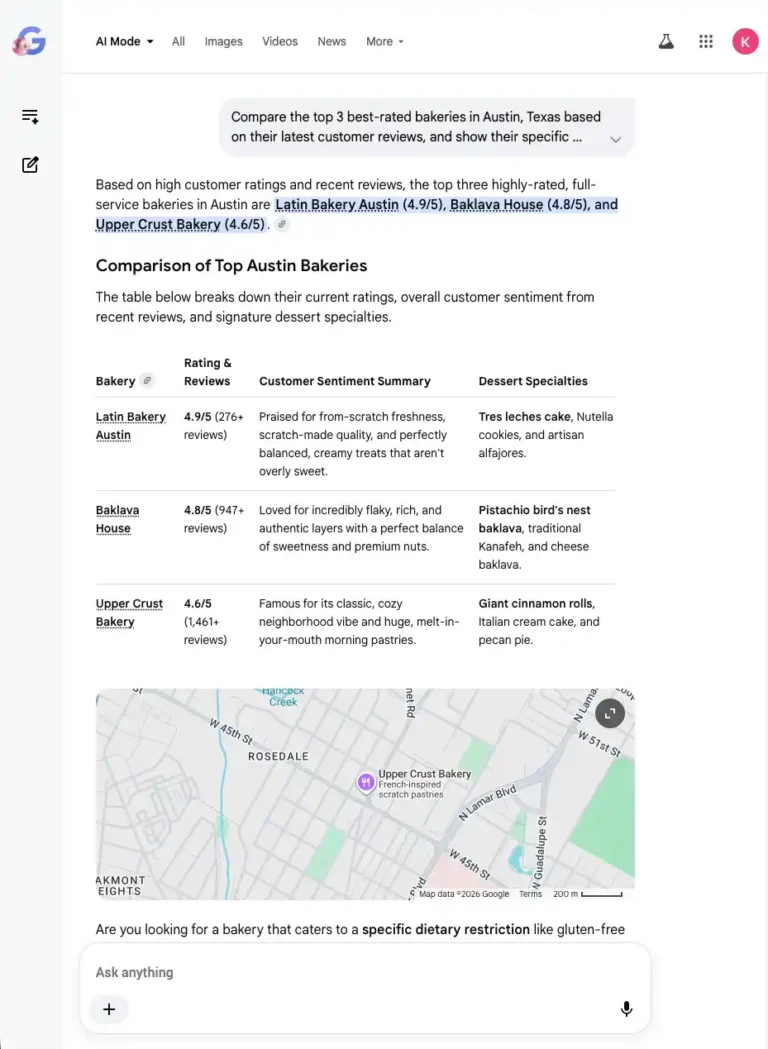
To understand how Google AI search is changing the search experience, compare the results generated from the same query:
“Compare the top 3 best-rated bakeries in Austin, Texas based on their latest customer reviews.”
Figure 1. Traditional Google Search combines AI-generated summaries with external links.
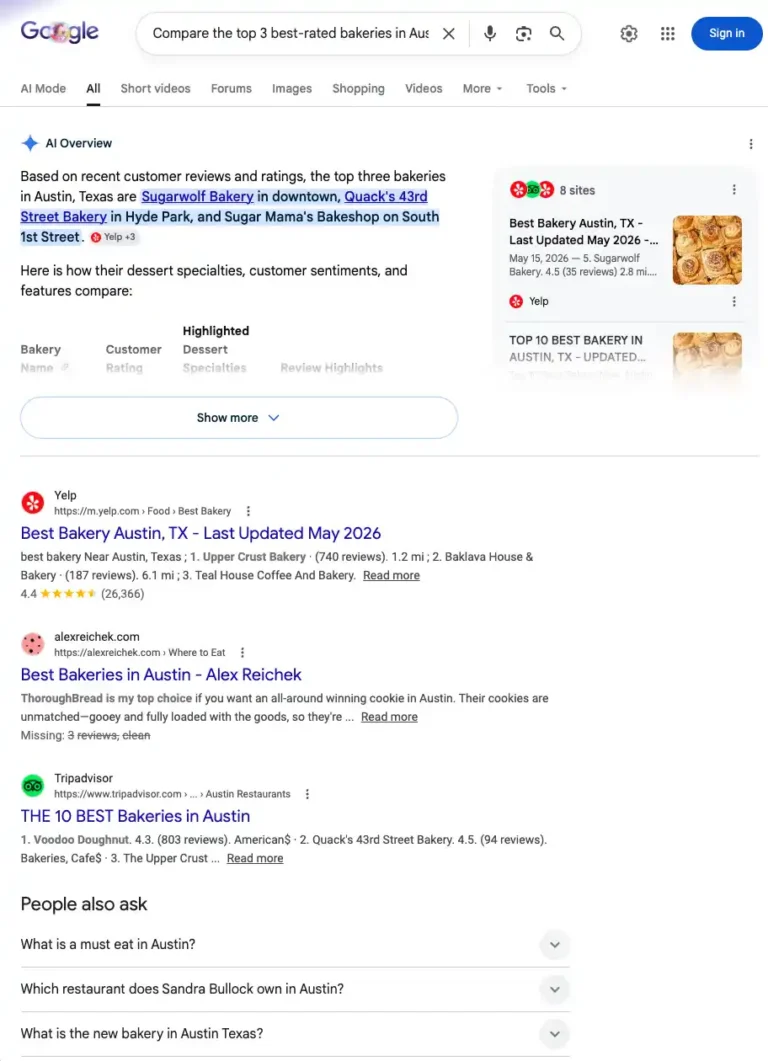
Figure 2. AI Mode synthesizes ratings, reviews, and business details directly within Search.
What’s Different?
Traditional Search (Figure 1): Google provides an AI-generated summary alongside links to websites such as Yelp, TripAdvisor, and others. While users can expand additional information, the experience still centers around navigating to other sites for deeper research.
AI Mode (Figure 2): Google presents a more structured comparison directly within the search experience. Business information, including ratings, review sentiment, specialties, and locations, is organized into a detailed table, allowing users to compare businesses without manually opening multiple sources.
Why This Matters for Businesses
Both experiences rely heavily on publicly available information, particularly customer reviews, ratings, and reputation signals.
The difference is how that information is presented. Instead of simply listing sources, AI Mode synthesizes information from multiple locations into a single response that users can continue exploring through follow-up questions.
For businesses, this reinforces the growing importance of maintaining strong review profiles, consistent business information, and a positive online reputation. These signals help shape the information AI-powered search experiences use when summarizing and comparing businesses.
The Most Advanced Google AI Search Features Are Still Limited
Google’s most advanced “agentic” AI features are not yet available to everyone.
At I/O 2026, Google introduced premium AI capabilities through Google AI Pro and Google AI Ultra, including background “Information Agents” in Search and autonomous tools like Gemini Spark.
These systems can perform multi-step research, monitor topics over time, and proactively surface information to users.
Google has also expanded agentic commerce experiences like Let Google Call, where AI can contact businesses on a user’s behalf to gather pricing, availability, and appointment information.
For now, many of these capabilities are limited to trusted testers and Google AI Ultra subscribers in the U.S.
While AI-powered search is becoming part of the core search experience, its most advanced autonomous features are still rolling out gradually.
SEO Has Evolved — Not Disappeared
Every major Google update tends to trigger claims that SEO is dead. What’s actually happening is a shift in what successful optimization looks like.
Traditional tactics focused heavily on exact-match keywords, high publishing volume, and ranking individual pages.
Google’s own documentation emphasizes creating helpful, reliable, people-first content while demonstrating experience, expertise, authoritativeness, and trustworthiness (E-E-A-T).
In other words, Google AI search still needs high-quality websites. The difference is that search engines are becoming better at evaluating which sources are actually valuable.
Google AI search increasingly rewards:
- Topical expertise
- Original insights
- Trusted brands
- Structured information
- Genuinely useful content
Brand Authority Matters More Than Ever
As AI-generated answers become more common, users may engage less with generic websites and more with brands they already recognize and trust. That makes brand authority increasingly important.
Companies that invest in:
- Original research
- Expert commentary
- Proprietary data
- Clear positioning
- Audience trust
will likely perform better in Google AI search environments than sites producing large volumes of low-quality SEO content. This is especially important because AI systems still rely on authoritative sources to generate responses and citations.
Businesses Should Prepare for a Hybrid Search Future
Currently, traditional search results are not disappearing. Website traffic from Google still matters. Organic rankings still matter. Publishing valuable content still matters. But AI-assisted experiences are becoming a larger part of how users interact with search engines.
The immediate future of search is likely to be hybrid:
- Traditional web results
- AI-generated summaries
- Conversational interfaces
- Multimodal search
- Task-oriented AI tools working together
Businesses that adapt early will be in a stronger position as search behavior continues to evolve.
What Businesses Should Focus On Now
1. Create Original, High-Value Content
Generic SEO pages are becoming less effective. Unique insights and expertise matter more.
2. Build Topical Authority
Comprehensive content ecosystems around your core subjects help establish trust and relevance.
3. Strengthen Your Brand
Brand recognition is becoming more important as AI systems summarize information from multiple sources.
4. Improve Technical SEO
Structured data, crawlability, and clear site architecture remain critical foundations.
5. Optimize for AI Discovery
Content should be easy for both humans and AI systems to understand, summarize, and reference.
Businesses should also understand how AI-powered discovery systems work as search behavior evolves.
6. Diversify Traffic Sources
Relying entirely on Google organic traffic is increasingly risky in an AI-driven search landscape.
Why Reputation Signals Matter
As AI-powered search becomes more advanced, businesses are entering a new environment where visibility is no longer determined solely by rankings and keywords.
AI-powered search systems increasingly evaluate:
- Brand credibility
- Customer sentiment
- Authority signals
- Consistency across the web
- Real-world reputation
That shift has major implications for how companies compete online. In traditional search, businesses could often improve visibility primarily through technical SEO and content optimization. In Google AI search, reputation becomes part of discoverability itself.
When Google’s AI systems summarize businesses, compare providers, recommend local companies, or surface “best” options, they rely heavily on publicly available trust signals such as:
- Customer reviews
- Review velocity
- Response activity
- Business consistency
- Ratings across platforms
- Overall brand authority
That means online reputation management is no longer just a customer service function; it is increasingly tied directly to search visibility, conversion performance, and AI discovery.
Review Management in the Era of AI-Powered Search
Google AI search is designed to help users make decisions faster.
For local businesses, multi-location brands, healthcare providers, home services companies, agencies, and franchise organizations, reviews have become one of the most important forms of machine-readable trust data available online.
Businesses with:
- Stronger ratings
- More recent reviews
- Higher engagement
- Consistent customer feedback
are more likely to appear trustworthy to both customers and AI-powered recommendation systems.
As conversational search expands, users are increasingly asking highly intent-driven questions such as:
“What’s the best-rated dentist near me?”
“Which HVAC company has the best customer service?”
“What local agency has the strongest reviews?”
In those moments, reputation data becomes a significant competitive advantage.
How ReviewInc Fits Into The Google AI Search Shift
ReviewInc helps businesses strengthen the public-facing signals that search engines and AI systems evaluate, including:
- Authentic customer reviews
- Reputation management
- Customer engagement
- Local visibility
- Brand trust
The Value of Consistency
Consistent business information, review activity, and reputation signals remain essential for both traditional local SEO and AI-assisted search discovery.
For multi-location and enterprise organizations, centralized reputation management creates the consistency that AI-powered search systems increasingly rely on when evaluating brands.
Questions About Google’s AI Mode Search
What is Google AI search?
Google AI search is Google’s AI-powered evolution of traditional search. It combines AI Mode, Gemini integration, AI Overviews, and conversational search experiences to help users get answers, compare options, and complete tasks more efficiently.
Rather than relying solely on lists of links, Google AI search can summarize information, answer follow-up questions, and provide more personalized search experiences.
Does Google AI search mean SEO is dead?
No. Right now, SEO is evolving, but it has not disappeared. Google AI search still relies on websites, publishers, and authoritative sources to generate responses and citations.
Businesses that create helpful, people-first content, demonstrate expertise, and build strong brand authority will continue to benefit from organic search visibility.
What is AI Mode in Google Search?
AI Mode is Google’s conversational search experience powered by Gemini. It allows users to ask complex questions, continue conversations with follow-up prompts, and explore topics in greater depth.
AI Mode also supports multimodal inputs such as images, videos, documents, screenshots, and browser tabs, making search more interactive than traditional keyword-based queries.
How do AI Overviews affect business visibility?
AI Overviews can reduce the number of clicks users make to individual websites by presenting AI-generated summaries directly within search results.
As a result, businesses need to focus on creating authoritative, trustworthy content that Google can reference and cite within these AI-powered experiences.
Why are reviews and reputation still important?
Google AI search increasingly evaluates trust signals when recommending businesses. Customer reviews, ratings, review activity, brand authority, and consistency across the web all help AI systems determine which businesses appear most trustworthy.
Strong online reputation management can therefore influence both visibility and customer conversion opportunities.
How can businesses prepare for Google AI search?
Businesses should focus on creating original content, building topical authority, strengthening their brand, improving technical SEO, optimizing for AI discovery, and diversifying traffic sources.
They should also actively manage reviews and reputation signals, as these factors are becoming increasingly important in AI-assisted search and local business recommendations.
Businesses looking for practical strategies can learn more about how to show up in AI search results.