Explore our other guides on Google reviews.
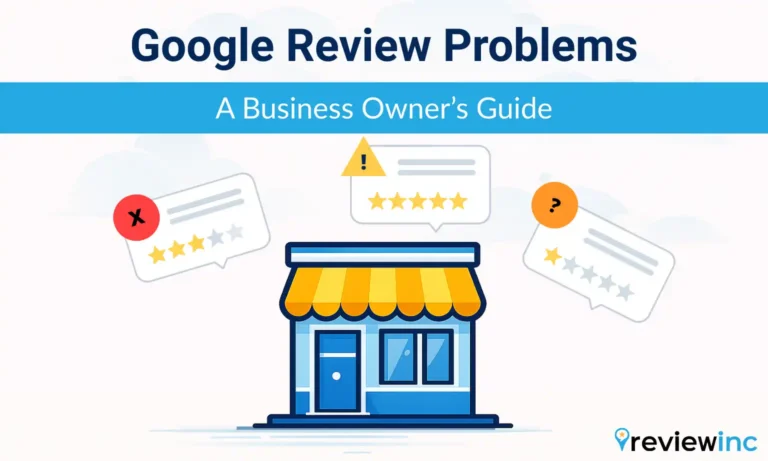
If you manage a business, you know review issues can negatively impact visibility, reputation, and revenue. Here are the most common Google review problems you might encounter and what you can actually do about them.
In This Guide
Deleted Google Review Problem
You saw the reviews. You read them. Now they’re gone.
Google uses a combination of automated systems and human review processes to evaluate review quality and determine whether content remains visible.
Why it happens
Google removes reviews because of:
- Automated spam detection
- Policy violations
- Suspicious review patterns
- Reviewer account restriction or removal
- Bulk moderation sweeps (legitimate reviews can get caught in Google’s automated systems)
What you should do
- Confirm the review is actually gone. Check while logged out or in an incognito browser window
- Document the change (date, review count, screenshots)
- Review Google’s content policies to identify possible violations
- Submit an appeal request, if appropriate
This is where having review tracking and reporting in place makes a measurable difference.Without a documented review history, it’s difficult to demonstrate a problem with Google review removal patterns or sudden changes.
What you can control
- Don’t offer good review incentives
- Maintain a constant review stream to avoid review count spikes
- Use only compliant review generation practices
- Monitor review count trends consistently
Google Reviews Are Missing or Delayed
Google may remove (missing reviews) or delay (hold for review) reviews from public display if they trigger automated quality signals.
Missing and delayed reviews are a slightly different problem from deleted reviews. Google has not necessarily deleted them; however, they are being suppressed based on automated quality assessments.
Review delays are sometimes temporary, and the review will appear several days later. However, most missing reviews are because of a policy violation and will remain invisible unless the reviewer changes or appeals it.
Why Google reviews are hidden
Google’s systems evaluate factors such as:
- Review quality and detail
- Suspicious behavior patterns
- Review velocity spikes (excessive numbers of positive or negative reviews in a short time)
- Incentivized review activity
- Conflict-of-interest signals
- Repetitive or low-value content
If you think a review is delayed, keep checking; it might appear in a few days. However, reviews removed for policy violations won’t be restored.
If you suspect reviews are being filtered, tracking review velocity and historical totals helps identify patterns early.
If your Google business profile was recently suspended, then reinstated, reviews might take 24 to 48 hours to reappear. If this happens, contact Google for assistance.
Get Found. Get Chosen.
Get Customers.
Manage reviews, improve rankings, stand out in search—all in one place
Fake or Spam Reviews
One of the most common Google review problems is fake or spam reviews, or reviews that do not reflect real customer interactions.
Google prohibits fake engagement, impersonation, and coordinated review manipulation under its review content policies.
Signs of fake reviews
- No record of the customer
- Generic or vague wording
- References to competitors
- Multiple similar reviews posted within a short timeframe
- Reviewer profiles with little or no activity
What you should do
- Document the review immediately with screenshots and timestamps.
- Compare wording if multiple reviews appear at once.
- Report the review or flag it inside your Google Business Profile.
- Reference the specific policy violation when submitting your report.
Google does not remove reviews simply because they are negative. Instead, removal decisions are based on whether the content violates policy.
When fake reviews hit, speed matters
Fake reviews can have a strong negative and costly impact on your business. When a suspicious review impacts your profile, having immediate access to knowledgeable support can help you flag, report, and respond quickly and appropriately.
ReviewInc’s Client Engagement team is experienced in helping report and resolve a variety of Google review problems.
Sudden Drop in Google Star Rating Problem
Sometimes you don’t know why, but your Google review rating drops overnight.
This problem can quickly affect visibility, especially for businesses with lower review volume.
Common causes include:
- Removal of older 5-star reviews
- A small number of 1-star reviews in a low-volume profile
- Rating recalculation after filtered reviews
- Review count corrections following moderation
Google dynamically calculates star ratings based on the reviews currently visible. As a result, when review volume is low, even one rating change can significantly shift your average.
What you should do
1. Audit the cause
Before reacting, determine whether the drop was caused by removed reviews, new negative reviews, or a system recalculation.
- Check whether several older 5-star reviews disappeared.
- Review any new 1-star ratings and confirm whether they are legitimate customers.
- Identify patterns that suggest spam, coordinated activity, or filtering.
If you suspect policy violations, document everything before reaching out to Google or flagging the reviews.
2. Continue requesting Google reviews
Google weighs recent activity heavily. Generating fresh, high-quality reviews from real customers can help stabilize your rating over time.
Reach out to recent customers to request compliant, non-incentivized reviews.
A steady flow of authentic feedback reduces the impact of isolated rating shifts.
3. Respond professionally
If a review feels fake or just unfair, your response affects how current and future customers perceive your business.
- Keep responses calm and brief, and offer to resolve concerns offline.
- If a review appears fake but Google does not remove it, respond professionally, stating that you have no record of the specific incident, and invite direct offline contact.
4. Escalate when appropriate
If you believe the rating change resulted from a technical issue or mass removal of compliant reviews, you can submit an appeal.
- Collect proof showing your previous rating and review count
- Provide dates and clear details
- Reference specific policy considerations in your request
Understanding volume sensitivity
Star ratings behave differently depending on how many total reviews you have.
- Low-volume profiles (1–10 reviews) are highly sensitive; one rating can shift the average significantly.
- High-volume profiles (100+ reviews) are more stable; individual ratings have less impact.
Tracking rating trends over time provides context. Otherwise, you’re reacting without data.
Diversify your review presence
Relying on a single platform increases risk. Collecting reviews across multiple platforms helps stabilize your overall online reputation if one platform recalculates or filters content.
Google Review Extortion Problem
Review extortion is when someone threatens to leave, or has already left, a negative review unless you provide money, discounts, refunds, or something of value in return.
Under its content policies, Google prohibits review extortion and removes reviews tied to coercion or threats.
What is a Google review extortion problem
- A customer demands a refund in exchange for removing a negative review
- A reviewer threatens to post multiple bad reviews unless compensated
- A competitor implies that they will damage your rating unless you take a specific action
- A reviewer states they will change their rating only if they receive something of value
What you should do
- Do not negotiate or engage with the person making the threat
- Document all communication, including screenshots and timestamps
- Submit a Google Review Merchant Extortion Form
Fraudulent “review removal” schemes
Some bad actors leave negative reviews under fake names, then contact the business posing as a legitimate service offering to “remove” the review for a fee. These schemes rely on pressure and urgency.
- Do not pay for review removal
- Document the activity of the reviewer and “removal company”
- Use Google’s Merchant Extortion Form to report the incident
Extortion cases require careful documentation. Act quickly and follow Google’s reporting process.
A Partner In Protecting What You’ve Built
Your Google rating is a digital storefront and often the first thing a potential customer sees. As we’ve explored, that rating can be surprisingly fragile. Whether it’s a sudden algorithm shift or a stray 1-star review, these fluctuations are stressful when you’re trying to focus on your day-to-day operations.
A Dedicated Reputation Partner
ReviewInc is your dedicated reputation partner, helping you stay ahead of the curve by:
- Continuous Monitoring: Reporting to help identify review fluctuations when they happen, so you aren’t caught off guard by a sudden drop in your star rating.
- Historical Data Archiving: Maintaining a record of your review history. If Google accidentally wipes out legitimate 5-star reviews, having that documentation is vital for a successful appeal.
- Expert Appeal Support: Navigating Google’s complex support system can be exhausting. Professionals know exactly which policies to cite and what evidence to provide to increase the likelihood of removing a fake or extortionate review.
- Sustainable Review Growth: Instead of “review spikes” that trigger Google’s spam filters, ReviewInc helps you request a steady stream of fresh feedback from real customers, keeping your rating resilient.
You don’t have to manage these technical hurdles alone. Having our team in your corner helps your online reputation stay strong. Learn more about what ReviewInc can do to help build and protect your company’s reputation.
Questions About Google Review Problems
Why did my star rating drop even though I didn’t get any new negative reviews?
Google review star rating drops sometimes occur when older 5-star reviews are removed during moderation or when filtered content is excluded from the rating calculation. Because Google calculates ratings dynamically based only on visible reviews, losing just one or two high ratings can significantly affect low-volume profiles.
Why would Google remove my 5-star reviews?
- The reviewer’s account was deactivated
- Google flagged the review during a “policy sweep”
- Unnatural patterns
- Old incentivized reviews
- Spikes from specific or untrustworthy accounts
How do I recover reviews that disappeared?
There is no automatic way to restore removed reviews. If legitimate reviews disappear, document the change and submit a reinstatement request through the Google Business Profile support process. Historical documentation improves the likelihood of a successful appeal.
Why are customer reviews hidden but not deleted?
Some Google review problems involve filtering rather than deletion. Reviews may be suppressed due to automated quality signals, unusual review velocity, IP conflicts, or account credibility issues. In some cases, reviews reappear after automated checks are completed.
How do Google review problems impact local search visibility?
If your average rating drops below certain thresholds, your visibility in local search results queries may decline. Because Google weighs rating quality and recency, resolving review issues quickly and maintaining a steady stream of compliant feedback helps stabilize visibility.
Can I pay to remove bad Google reviews?
No. You cannot pay to remove negative Google reviews. Google removes reviews only when they violate its documented policies. You should also never pay for positive reviews. It violates Google’s policies and can result in review removal, account suspension, or restrictions on your Business Profile.
Additionally, if someone threatens or tries to extort your business by leaving negative reviews, do not engage. Document the communication and report the review under Google’s review extortion policy. Removal decisions are based on documented policy violations.
Does responding to Google reviews help my star rating?
Responding to reviews doesn’t improve your Google reviews rating, but it helps your overall business reputation. Google states that businesses that respond are seen as valuing their customers, which can help your business stand out.
The occasional negative review is part of life for business owners, and learning how to respond to them is important. Your review response shows the type of business you are to the reviewer, current, and potential customers.