Explore our complete series on AI search and AI visibility for businesses.
Key Takeaways
How AI recommends local businesses is changing as consumers increasingly use AI to discover and evaluate nearby options.
Strong reviews, accurate listings, and trusted content help businesses appear in AI recommendations.
Local SEO and reputation management now play an important role in both traditional and AI search visibility.
For years, local search rewarded proximity. If your business was closer than your competitor’s, you often had an advantage.
Today, that’s only part of the story.
Understanding how AI recommends local businesses requires a different way of thinking. AI isn’t simply trying to find the closest business. It’s trying to recommend the best answer.
When someone asks ChatGPT, Gemini, or Google’s AI-powered search, “Who’s the best HVAC company near me?” distance is only part of the equation. These platforms are making a recommendation. And recommendations require confidence.
Every review, business listing, customer photo, and owner response becomes another piece of evidence. Together, those trust signals help AI answer one question:
Can I confidently recommend this business?
That’s the new challenge for local businesses. It’s no longer just about getting found. It’s about becoming the business AI is confident recommending.
In This Article
How AI Recommends Local Businesses: From Search Results to Recommendations
Traditional search was built around discovery. You typed a query, Google returned a list of businesses, and you compared ratings, reviews, photos, websites, and locations before deciding who to call.
AI search changes that process. Instead of presenting a list and asking you to decide, AI can narrow the field and recommend businesses that fit the question.
Customers aren’t just searching “plumbers near me.” They’re asking “Who’s the most reliable plumber near me?” or “Which HVAC company would you recommend?”
Those aren’t simply search queries. They’re recommendation requests.
This shift is also contributing to more zero-click searches, where customers can get answers directly within search experiences rather than following the traditional path from search result to website.
Understanding how AI recommends local businesses means recognizing this shift from being listed to being selected. And that changes what businesses need to optimize for.
Distance Still Matters, But Doesn't Tell the Whole Story
Distance remains an important part of local search, especially when someone clearly needs a nearby business. Google identifies relevance, distance, and prominence as the primary factors it uses to determine local results.
But the right distance can depend on what the customer is asking for. Someone looking for a common service may have plenty of qualified options within a few miles. Someone looking for a specialized service may need to look further.
That means proximity still helps define which businesses are relevant, while the context of the request can influence how wide that consideration set becomes.
AI Can Only Recommend What It Can Verify
AI doesn’t visit your office, talk to your customers, or inspect your work. It doesn’t actually know whether you’re the best plumber, dentist, attorney, or contractor in town. What it does have is evidence.
If someone searches:
“Who’s the most reliable HVAC company near me?”
AI has to evaluate the information available online about each business. That evidence can come from several places:
- Business information: Your website, service pages, business profiles, listings, and structured data.
- Customer evidence: Reviews, ratings, customer feedback, and photos.
- Third-party corroboration: Relevant directories, local publications, professional organizations, and other independent mentions.
- Current information: Recent reviews, updated hours, current listings, new photos, and accurate website content.
The more complete, current, and consistent the evidence is, the easier your business is to understand and verify.
How AI recommends local businesses isn’t really about discovering a secret new algorithm. It’s about giving AI enough reliable information to answer one important question:
Can I confidently recommend this business?
That question gives local businesses a much clearer strategy for what to do next.
How to Become a Business AI Can Recommend With Confidence
There isn’t a single magic AI business-recommendation ranking factor to optimize.
Instead, focus on making your business easy to understand, verify, and trust across the places where AI systems can encounter information about it.
Here are five places to start.
1. Build a Review Profile AI Can Understand
Getting more reviews is only part of the job.
Reviews provide context about what your business actually does and how customers experience it.
Compare these two reviews:
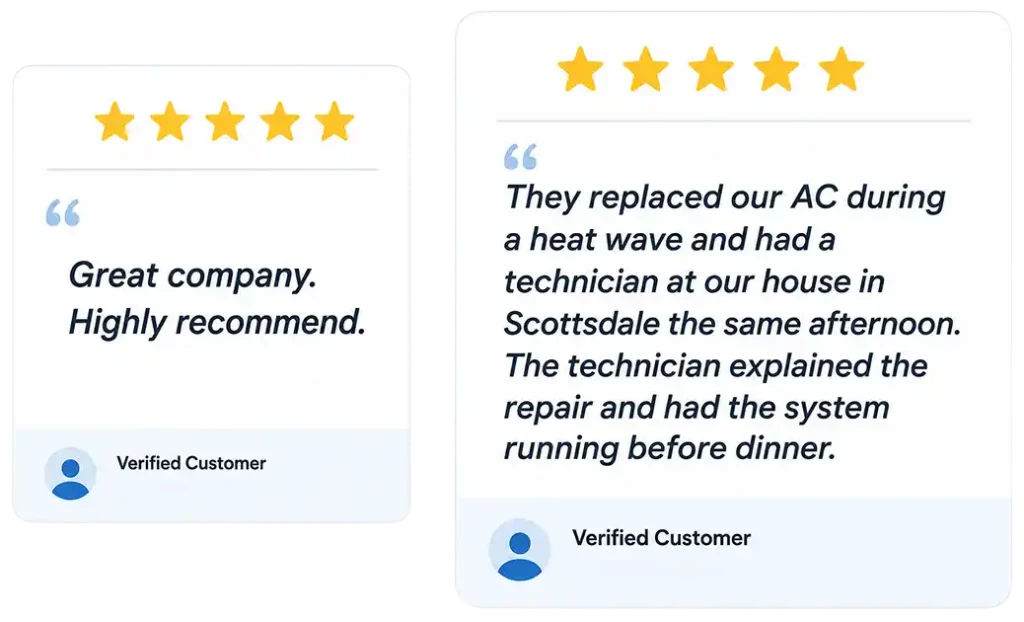
“Great company. Highly recommend.”
versus:
“They replaced our AC during a heat wave and had a technician at our house in Scottsdale the same afternoon. The technician explained the repair and had the system running before dinner.”
The second review contains far more useful context. It describes a service, location, experience, and outcome.
That doesn’t mean you should tell customers what to write. You shouldn’t. Ask for honest feedback and let customers describe their experiences naturally.
Over time, detailed customer language can help establish recurring associations between your business and the services, locations, and experiences customers actually mention.
Review recency matters here, too. Hundreds of reviews from years ago tell a different story than an established review profile that continues receiving feedback today.
Owner Responses Add Context
Don’t stop once the review is published.
Responding gives you an opportunity to acknowledge the customer, address concerns, and add useful context where appropriate. It also shows that the reputation people and AI systems encounter online is connected to an active business.
For AI business recommendations, a current body of customer feedback provides more useful evidence than a static star rating alone.
2. Make Your Business Easy to Verify Everywhere
AI shouldn’t encounter five different versions of your business.
Your business listings, including name, address, phone number, website, hours, categories, and other core information, should be accurate and consistent across the major platforms where your business appears.
That includes Google Business Profile, Apple Business Connect, Bing Places, Yelp, Facebook, and relevant industry directories.
One listing with old hours may not seem significant. But when outdated phone numbers, duplicate listings, old addresses, and conflicting categories accumulate across the web, your business becomes harder to understand.
Think of listing consistency as a way to reduce ambiguity.
When multiple credible sources agree on who you are, where you’re located, and what you do, your business becomes easier for search and AI systems to verify.
Complete Your Profiles, Not Just Your NAP
Consistency isn’t limited to your name, address, and phone number (NAP).
Categories, services, hours, service areas, website, descriptions, and other available profile fields provide additional context.
“Find an HVAC contractor near me” is broad.
“Find an HVAC contractor near me that repairs heat pumps and offers emergency service” requires much more information about what each company actually does.
The businesses that clearly document those services are easier to understand in the context of a specific request.
3. Give AI Enough Context to Understand What You Do
Your business listings establish the basics. Your website should establish the details.
If you offer ten distinct services but summarize everything on one generic services page, you’re providing limited information about your expertise.
Create useful, substantial pages around the services you actually provide. Explain what the service is, who it’s for, where you provide it, common customer questions, and relevant details that demonstrate real expertise.
The same principle applies to locations. If you serve multiple communities, make those service areas clear without creating dozens of thin, nearly identical location pages.
Clear site structure, descriptive headings, useful FAQs, internal links, and appropriate structured data, such as LocalBusiness schema, can also make important information easier for search systems to interpret. These elements can also help businesses show up in AI search results by giving AI systems clearer information about their services, expertise, and authority.
Write for the Questions Customers Actually Ask AI
Keyword research still has value, but conversational AI changes the shape of the query.
Someone may type:
“emergency plumber Phoenix”
into a traditional search box.
That same person might ask an AI assistant:
“Who is a reliable emergency plumber near me that can come out tonight?”
The second question contains more context and clearer intent. Your online presence needs enough information to help establish whether your business actually fits that request.
This is one reason clear answers, descriptive headings, specific service information, and well-organized content matter for AI business recommendations.
If terms such as AI Overviews, GEO, structured data, and LLMs are unfamiliar, our AI search glossary explains the terminology.
4. Keep Your Digital Footprint Current
Trust isn’t only about what the internet says about your business. It’s also about whether that information still reflects the business operating today.
A profile with outdated hours, a website that hasn’t been updated, old photos, and no recent customer feedback creates a very different picture from an active business with current information.
Keep your online presence current.
- Continue requesting authentic customer reviews.
- Respond to new feedback.
- Add relevant, current business and project photos.
- Keep hours and service information accurate.
- Update important website information when it changes.
- Correct outdated or duplicate listings when you find them.
Freshness works best when it’s the natural result of actively managing your digital presence, not a content quota.
Google’s move toward AI Mode and other conversational search experiences makes this increasingly important because users can ask much more specific questions about businesses, services, ratings, locations, and customer experiences.
5. Build Authority Beyond Your Own Website
You can say you’re the best electrician in town. That’s your claim.
When customers, local publications, professional organizations, industry directories, and other independent sources consistently associate your company with electrical services in that community, that’s corroboration. That distinction matters.
A strong digital footprint extends beyond assets you control. Relevant third-party mentions can reinforce your business identity, location, expertise, and reputation.
Depending on the business, those sources might include:
- Local news publications
- Chambers of commerce
- Professional associations
- Community organizations
- Industry publications
- Respected local directories
The goal isn’t to accumulate mentions anywhere you can get them. It’s to build a business that credible sources have legitimate reasons to mention.
That creates a stronger network of evidence around your brand and gives AI business recommendations more to work with than your own marketing claims.

Nearby or Most Trustworthy? Compare the Evidence
Now put two electricians side by side.
Both serve the same neighborhood. Business A happens to be slightly closer.
Their online presence tells two very different stories.
| Trust Signal | Business A | Business B |
|---|---|---|
| Review Volume | 18 reviews | 462 reviews |
| Review Recency | Last review 11 months ago | New reviews every week |
| Owner Engagement | Rarely responds | Responds consistently |
| Business Photos | Few recent photos | Current customer and project photos |
| Business Profile | Incomplete | Complete and current |
| Business Listings | Conflicting information | Accurate across major platforms |
| Website Content | One generic service page | Detailed pages explaining core services |
| Third-Party Signals | Few relevant mentions | Relevant local and industry mentions |
Business B isn’t automatically the better electrician. But it has substantially more evidence to evaluate.
Business B is easier to identify and understand, supported by more customer experiences, and backed by more up-to-date information.
Now, suppose Business A is two minutes closer. Are those two minutes enough to overcome everything else? Maybe not.
That’s the important distinction in how AI recommends local businesses.
Proximity can establish you as an option. Trust signals can help establish that you’re the option worth recommending.
Start by Seeing What AI Search Sees
The best place to start improving your visibility in AI search is by looking at your business the way a potential customer might.
Search for your business and core services. Then ask ChatGPT, Gemini, and Google’s AI-powered search the same questions a prospective customer might ask.
Look for gaps:
- Is your business appearing in relevant recommendations?
- Is the information being surfaced accurate?
- Are competitors appearing when you aren’t?
- Are your reviews recent and representative of your actual services?
- Do your listings agree with one another?
- Does your website clearly explain what you do and where you do it?
- Are credible third-party sources reinforcing your expertise?
ReviewInc’s free Visibility & Reputation Report can help you identify gaps across reviews, listings, local search, AI visibility, and website readiness.
The Local Search Advantage Is Becoming Trust
For years, local search focused heavily on getting businesses found. AI search adds another hurdle: getting selected.
That’s the larger shift behind how AI recommends local businesses. Being close still matters. Relevance still matters. But when several businesses can satisfy the same local need, AI has to distinguish among them.
- Reviews provide customer evidence.
- Accurate listings establish identity.
- Detailed website content explains expertise.
- Current activity shows that information still reflects the business today.
- Independent mentions provide third-party corroboration.
Together, these signals create something proximity alone can’t provide: confidence.
Local businesses don’t need to chase every new AI optimization tactic. They need to make their real-world reputation clear, consistent, up to date, and verifiable online.
Questions About How AI Recommends Local Businesses
How does AI recommend local businesses?
AI can evaluate information from multiple online sources to determine which businesses are relevant and credible for a user’s request. Depending on the search experience, that information can include business profiles, websites, reviews, ratings, directories, structured data, and other publicly available sources.
Exactly how AI recommends local businesses varies by platform and query, which is why businesses benefit from maintaining clear and consistent information across their broader digital presence.
Does distance still matter when AI recommends a local business?
Yes. Proximity remains relevant when location is important to the request, but the importance of distance can change with the user’s intent.
Someone asking for a “plumber near me” is explicitly emphasizing location. Someone asking for “the best-rated emergency plumber that serves my neighborhood” is providing additional criteria that may influence the recommendation, including reputation, availability, services, and other factors.
When several qualified businesses can all serve the same customer, distance doesn’t necessarily tell the whole story.
Do reviews influence AI business recommendations?
Yes. Reviews can provide valuable third-party evidence for AI business recommendations because they describe actual customer experiences.
Volume and recency provide useful context, but the substance of reviews matters too. Detailed customer feedback can contain information about specific services, experiences, outcomes, and locations that help create a clearer picture of what a business is known for.
Businesses should never tell customers to insert specific keywords into reviews. Authentic, detailed feedback is far more valuable than manufactured language, and asking customers to include specific wording may also violate the guidelines of major review platforms.
How can a local business improve its chances of being recommended by AI?
There is no guaranteed formula for inclusion in an AI-generated recommendation. The objective is to make your business easier to understand, verify, and evaluate.
To do that, start with five fundamentals:
- Build a consistent stream of authentic customer reviews.
- Keep business information accurate across major platforms.
- Create detailed website content explaining your services and locations.
- Keep reviews, photos, listings, and website information current.
- Earn legitimate third-party mentions that reinforce your expertise and reputation.
Is AI replacing traditional local search?
AI search is changing how people discover local businesses because customers can increasingly ask for a recommendation rather than manually compare a list of nearby options.
Google’s AI Mode and AI Overviews, along with conversational tools such as ChatGPT and Gemini, illustrate this broader movement toward generated answers, comparisons, and recommendations.
For businesses, that changes the objective. Being visible still matters, but visibility alone may not be enough. Businesses increasingly need a digital presence that provides enough credible information to be considered recommendable.