Google built its dominance by being the place people go to find information. Now, Google review restrictions are limiting access to some of its most valuable information, and AI search engines appear to be looking elsewhere.
Google Maps now shows visitors only a handful of business reviews before asking them to sign in. For consumers, that’s a minor inconvenience. These restrictions could push AI search engines to stop relying on Google and turn to other websites when deciding which businesses to recommend.
ReviewInc’s AI live search testing suggests that the shift is already happening.
In This Article
Key Takeaways
- • Google review restrictions limit how many reviews visitors can read without signing in.
- • AI platforms outside Google can still see a business’s star rating and review count, but only a small, unpredictable sample of its reviews.
- • In recent ReviewInc AI live search tests, Google was often cited only by its own Gemini.
- • Other review sites, especially industry-specific platforms, are gaining influence in AI recommendations.
- • Businesses that rely on Google reviews alone risk becoming less visible in AI search.
What Did Google Change?
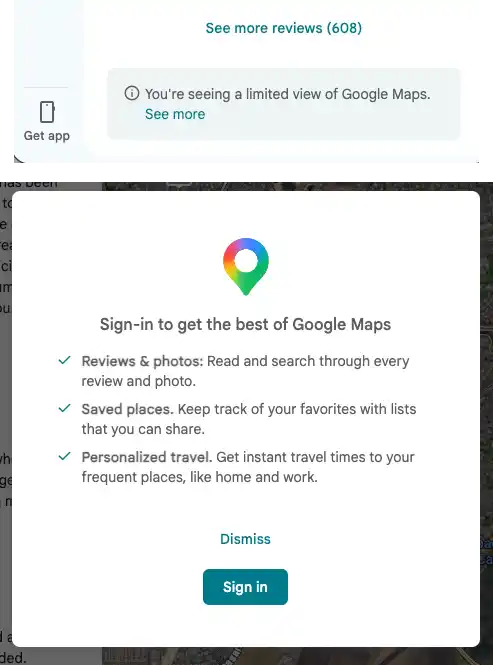
Google Maps now displays a limited view and prompts visitors to sign in to read and search through all customer reviews.
Google Maps now displays only a small number of reviews, roughly three to five, before asking visitors to log in. The change was documented by Search Engine Roundtable in September 2026.
Google hasn’t made an official announcement explaining the restriction. It briefly tested a similar restriction in February 2026 before rolling it back, and didn’t comment then either. Signed-in users can still read every review. But anyone who isn’t signed in now sees only a fraction of a business’s customer feedback.
That includes AI search engines.
Why Google's Review Restrictions Matter for AI Search
AI platforms outside Google’s ecosystem can still find a Google Business Profile. They can see a business’s name, address, star rating, and review count. What they can’t see is the depth of customer experience behind that rating.
Even Google’s Places API, a common way for outside platforms to access Google business data, returns only about five reviews per business. Those reviews aren’t chosen by the business or the AI engine. Are they the five best? The five worst? The five most recent? There’s no way to know.
When an AI engine is deciding which business to recommend, a star rating and five unknown reviews aren’t much to go on. So it looks elsewhere.
What ReviewInc's AI Live Search Testing Shows
Understanding AI Search: In-Memory vs. Live Search
Not all AI search results work the same way. Understanding the difference helps explain where AI recommendations come from.
- In-memory search: AI answers questions using information learned during training, which may be months or even years old. It doesn’t check the web for new information.
- Live search: AI actively searches the web for current information, including business listings, reviews, and other sources it can access.
What ReviewInc's Live Search Results Reveal
Live search offers a different perspective. It can reveal which websites an AI engine references when gathering information to answer a question.
That’s why ReviewInc examines live search results to understand which businesses AI engines recommend, how often they appear, and which websites provide customer reviews, business listings, and other information used in those recommendations.
ReviewInc’s recent live search tests show something surprising: AI engines aren’t relying on Google reviews as expected.
What AI Search Reveals About Restaurant Reviews
To see how Google review restrictions may be affecting AI search, ReviewInc tested where five leading AI engines get their information when recommending local businesses.
Across numerous ReviewInc AI Live Search reports, we’re seeing a similar pattern: AI engines identify a wide range of websites as sources of customer reviews, while Google Maps often appears as a source of business information rather than customer feedback.
Three examples stand out.
First, we examined one of the busiest locations of a major national burger chain. Despite having more than 22,000 Google reviews, only Google’s own Gemini identified Google Maps as a source of customer reviews when generating recommendations for local burger restaurants.
The five AI engines drew on very different sources:
- Gemini: Identified Google Maps as a source of customer reviews, along with Eater LA, Thrillist, Fatburger, and The Habit Burger Grill.
- Claude: Referenced Yelp, The Shack Playa del Rey, Travel Today LA, Tripadvisor, and SFGate.
- Grok: Referenced Yelp, Eater LA, The Habit Burger Grill, Condé Nast Traveler, and Time Out LA.
- Meta AI: Referenced LA Foodie, an In-N-Out burger review site, Secret Los Angeles, Trip.com, and YellowPages.
- ChatGPT: Referenced the In-N-Out website, The Apple Pan, Shake Shack, Five Guys, and Father’s Office.
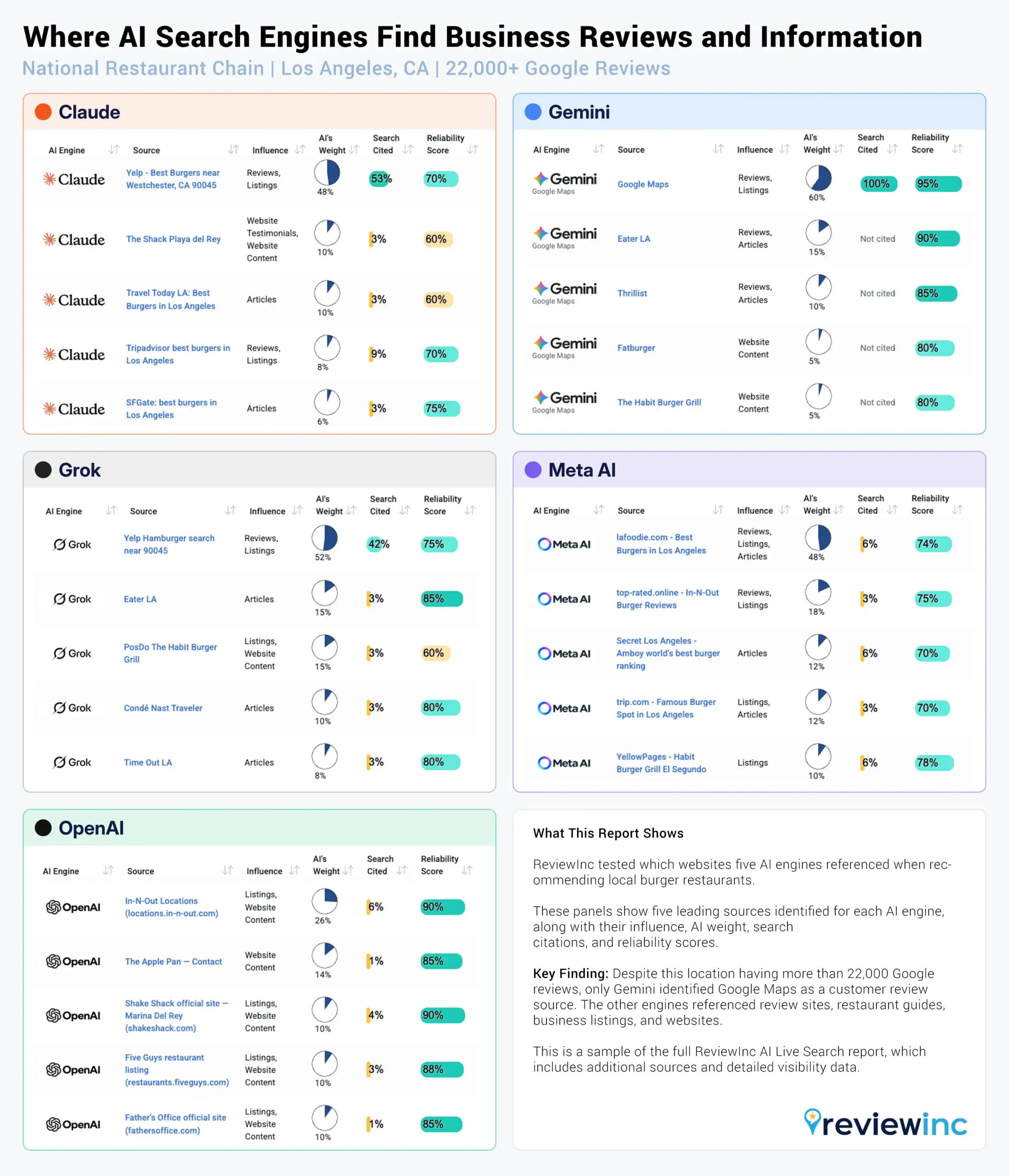
ReviewInc's AI Live Search report shows that only Gemini identified Google Maps as a customer review source for a restaurant location with more than 22,000 Google reviews.
The Same Pattern Appears in Automotive Services
ReviewInc’s AI Live Search testing at a location of a major national automotive service chain in Burbank, California, revealed a similar pattern. Despite having a 4.8-star Google rating and over 2,500 Google reviews, Google’s own Gemini was the only AI engine that identified Google Maps as a source of customer reviews.
The five AI engines drew on very different sources:
- Gemini: Identified Google Maps as its dominant source, accounting for 100% of its AI weight.
- Claude: Relied heavily on Yelp and also referenced CARFAX and automotive service websites.
- Grok: Identified Yelp as its leading source, along with the automotive chain’s website and other automotive service websites.
- Meta AI: Referenced local automotive review sites, MapQuest, business directories, and service websites.
- ChatGPT: Drew on the chain’s website, competing automotive service websites, and local business directories.
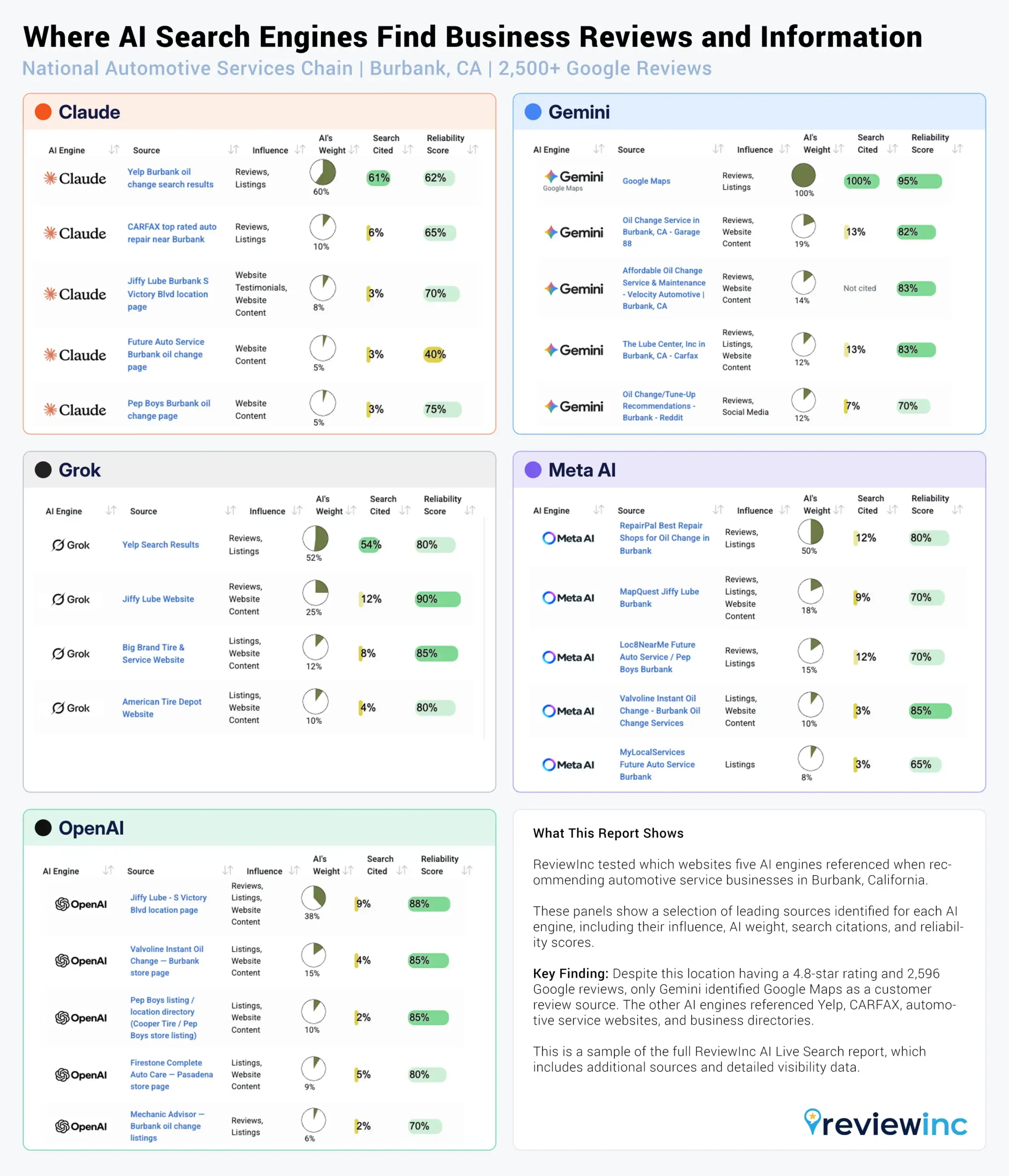
ReviewInc's AI Live Search report shows that only Gemini identified Google Maps as a customer review source for an automotive service location with over 2,500 Google reviews.
We saw the same pattern in a third industry. A location of a major national pest control company had more than 2,200 Google reviews, yet only Google’s own Gemini identified Google Maps as a source of customer reviews. The other four AI engines referenced sources such as Yelp, industry-specific websites, business directories, and pest control company websites.
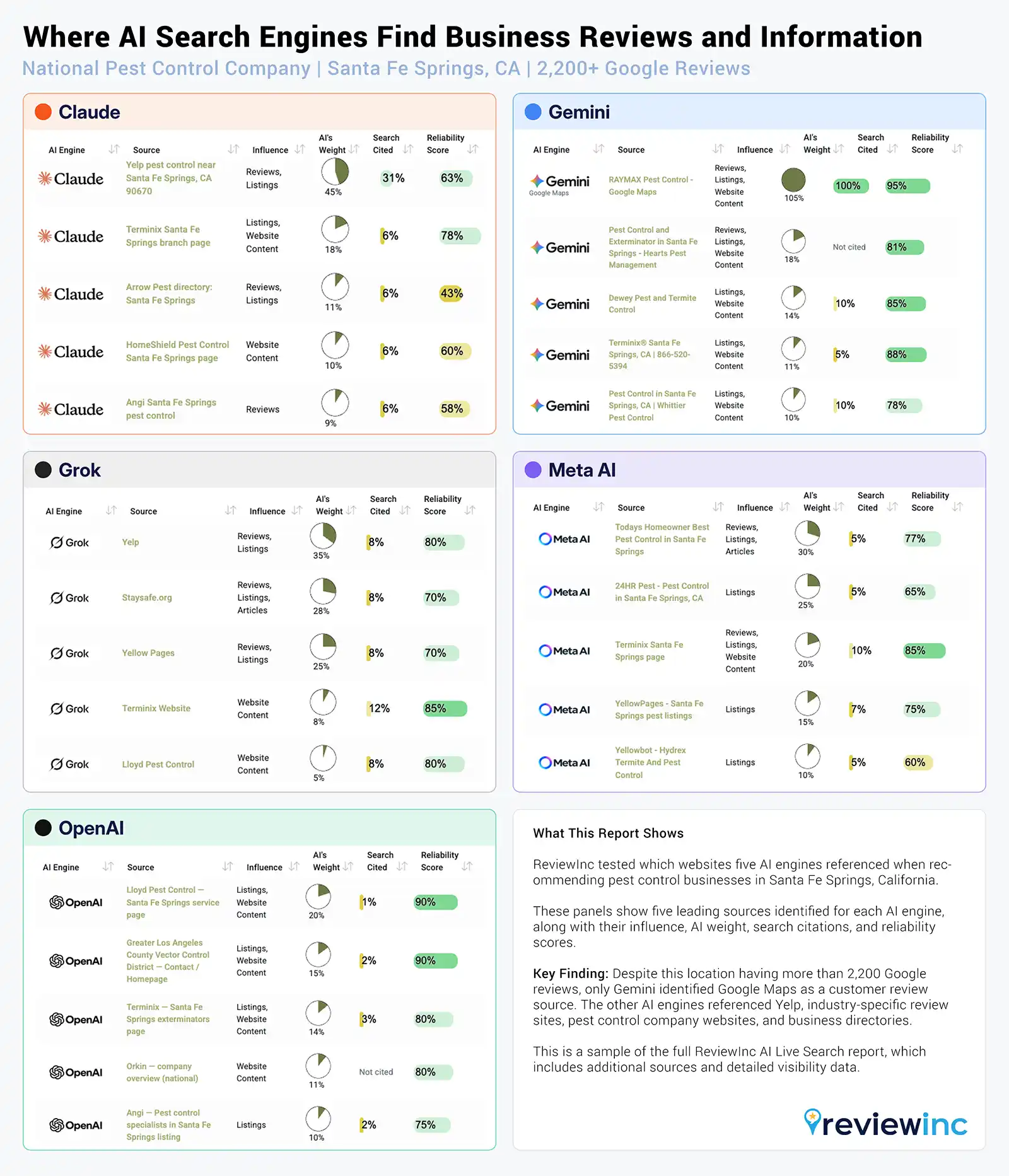
ReviewInc's AI Live Search report shows that only Gemini identified Google Maps as a customer review source for a pest control location with over 2,200 Google reviews.
Where Else Is AI Finding Reviews?
Some of the most surprising sources aren’t the major review platforms business owners already know. Across these reports, AI engines referenced websites such as Secret Los Angeles, Trip.com, MapQuest, Staysafe.org, and Yellowbot. They even referenced competitors’ websites.
These are places many businesses may never think to monitor, yet they’re appearing in the information AI engines use to recommend local businesses.
The takeaway isn’t that Google reviews no longer matter. It’s that businesses can have thousands of Google reviews, but AI engines are looking elsewhere for customer feedback and business information.
This reinforces why reputation management needs to extend beyond Google reviews.
Our Take: Less Data, Less Influence
Google has spent years building an enormous collection of customer reviews. Now it’s restricting how much of that feedback is openly available.
In our reports, Google Maps still appears as a source of business information. But outside Google’s own Gemini, other AI engines frequently identify different websites as sources of customer reviews.
That’s the risk for Google. If AI engines can find more useful customer feedback elsewhere, Google’s enormous collection of reviews may carry less influence outside its own ecosystem.
For businesses, the lesson is just as important. A reputation concentrated on one platform leaves gaps wherever AI engines look somewhere else.
Google hasn’t commented publicly on the change. It may eventually offer AI companies special access, possibly for a price. Until then, AI engines appear to be finding what they need elsewhere. Businesses that rely on Google reviews alone could be left behind.
Do Google Reviews Still Matter?
Absolutely. Google reviews remain important for Google Search, Google Maps, and Gemini. Businesses should continue collecting them.
But a strong Google rating isn’t enough on its own. As our AI Live Search reports show, other AI engines are looking beyond Google Maps for customer feedback and business information.
The goal isn’t to replace Google reviews. It’s to diversify where your business builds and maintains its reputation.
That means maintaining a strong presence on Google while ensuring your business can also be found and evaluated on other relevant platforms.
How Businesses Can Respond to Google's Review Restrictions
1. Build Reviews Beyond Google
Google should remain part of your review strategy, but it shouldn’t be the only part. Identify the industry-specific review sites that matter in your field, like healthcare review platforms for medical practices or automotive review websites for dealerships and repair shops, and encourage customers to share honest feedback there.
The goal isn’t to collect reviews everywhere. It’s to build a credible presence on the platforms your customers use, and AI engines can see.
2. Make Customer Experiences Visible on Your Website
Customer testimonials, detailed service pages, and answers to common questions give AI engines context that star ratings alone can’t. Unlike reviews locked behind a login, content on your own website can be accessed by AI search engines.
3. Keep Business Information Consistent
AI engines need to understand what a business does, where it operates, and who it serves. NAP issues (name,
address, and phone number), like outdated addresses, inconsistent business names, and conflicting listings, make it harder. Regularly check your profiles, directories, and website for accuracy.
4. Respond to Customer Feedback
Thoughtful review responses show how a business handles compliments, concerns, and service issues, adding context beyond the star rating. Respond professionally, avoid disclosing private customer information, and don’t make promises you can’t keep.
5. Monitor Your AI Search Visibility
Reputation management used to mean collecting reviews, watching ratings, and responding to feedback. Those still matter. But businesses now also need to know how AI search platforms describe and recommend them, and the sources those platforms are actually using. Because AI answers change, track your visibility over time rather than relying on a single search.
Building a Reputation Beyond Google
Google may be betting that restricting its reviews protects their value. Our data suggests the opposite: the less AI engines can see, the less they rely on Google.
Businesses should continue collecting genuine Google reviews while building a presence on other platforms used by AI engines. A strong reputation across trusted review sites, business listings, and your own website helps you stay visible wherever customers search.
ReviewInc helps businesses do exactly that through review collection and monitoring, listings management, AI search visibility, website testimonials, and social media management.
Frequently Asked Questions About New Google Review Restrictions
Does Google Now Require Users to Sign In to Read Reviews?
Can AI Search Engines Still See Google Business Profiles?
Yes, but access to customer reviews can be limited. Google Maps still displays business details such as names, addresses, star ratings, and review counts. However, visitors who aren’t signed in may only see a small selection of written reviews before Google asks them to sign in.
That distinction matters because access to business information doesn’t necessarily mean access to a business’s full review history.
Are AI Search Engines Using Google Reviews?
ReviewInc’s AI Live Search testing shows that Google Maps frequently appears as a source of business information, but not necessarily customer reviews.
In our restaurant, automotive service, and pest control reports, only Google’s own Gemini identified Google Maps as a customer review source. The other four AI engines referenced a wider range of websites, including review platforms, business directories, industry-specific sites, local guides, and even competitors’ websites.
Some of these sources may be unfamiliar to business owners, which makes monitoring your reputation beyond Google increasingly important.
What Is the Difference Between In-Memory and Live Search?
AI engines can generate answers using previously learned information or by retrieving information through live web searches.
- In-memory AI search: Uses information learned during training, which may be outdated. It doesn’t actively check the web for current information.
- Live AI search: Searches the web for current information, including business listings, customer reviews, and other available sources.
Why does Google's review restriction matter for businesses?
Google’s review restrictions can limit how much customer feedback is publicly accessible without signing in. Meanwhile, ReviewInc’s AI Live Search reports show AI engines identifying sources well beyond Google Maps, including niche websites, local guides, business directories, and competitors’ websites.
Businesses need to know where they’re being discussed and represented, even on websites they may not currently monitor.
Are Google Reviews Still Important?
Absolutely. Google reviews remain an important part of a business’s online reputation. They influence how customers evaluate businesses and play a role in Google Search, Google Maps, and Google’s AI-powered experiences.
Businesses should continue to actively collect Google reviews while also building their reputation on other platforms used by AI search engines.
Can Customer Testimonials on a Business Website Help With AI Search?
Yes. Service pages, testimonials, case studies, FAQs, and location-specific content are openly available to AI engines and help explain what a business offers and why customers choose it.
How Can Businesses Improve Their Visibility in AI Search?
Businesses can strengthen their AI search visibility by collecting authentic reviews on Google and other relevant platforms, keeping listings accurate, publishing helpful website content, and monitoring how AI platforms represent them. No single activity guarantees a recommendation.